
Connecting Care
A new model of care for mental health, addiction and wellbeing support in Te Tai o Poutini
Connecting Care is a new approach to how people and whānau access and experience mental health, addiction and wellbeing support across the West Coast.
The model is designed to make support easier to find, easier to access and better
connected. It brings community organisations, health services, Kaupapa Māori Mental
Health Services, Hauora providers, social supports, peer services and specialist care
together as one coordinated system.
The model is designed to make support:
- Easier to find and access
- Better connected across organisations
- Responsive to people’s changing needs
- Available closer to where people live
- Culturally safe and appropriate
- Focused on recovery, wellbeing and what matters to the person and their whānau.
The aim is simple:
People should be able to access the right support, in the right place, at the right time -
without having to understand or navigate a complicated system on their own.
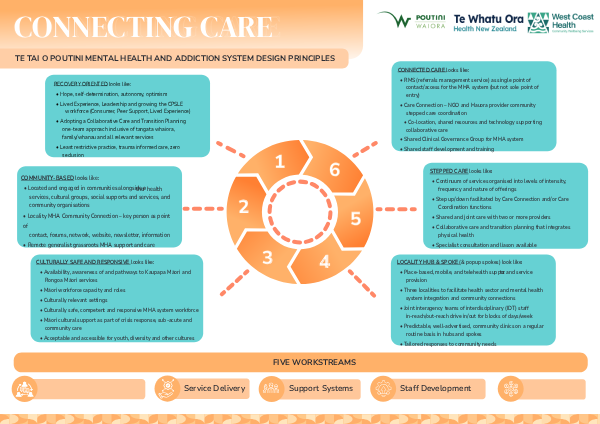
To view the new Connecting Care Model of Care diagram click here
To view the new Connecting Care Stepped Care Model diagram click here
To view the Connected Care Model Provider Diagram click here
The Connecting Care Model
The new Connecting Care Model is based on six connected design principles that bring together wellbeing and community supports, health services, Kaupapa Māori Mental Health Services, Hauora providers, social supports, peer services and specialist care together as parts of one coordinated system.
Designed with our communities
Connecting Care, the community hub and the website are being developed through co-design.
This includes working with:
- rangatahi with lived experience
- adults with lived experience
- whānau and supporters
- consumer, peer-support and lived-experience leaders
- people who deliver health, mental health, addiction and social services
- Kaupapa Māori and Hauora providers
- iwi
- rural and remote communities
- diverse cultures and communities of identity.
The experiences of people who use and deliver services will help shape how the model
works in practice, including the referral process, community hub, website and relationships
between providers.
Five areas of work
The programme is being developed through five connected workstreams:
1. Communications and engagement
2. Service delivery
3. Support systems
4. Staff development
5. Workforce
Together, these workstreams will support the practical changes required to implement the
new model.
Connecting Care is an evolving model, and we welcome questions, feedback and
suggestions from providers, community organisations, people with lived experience, whānau
and anyone involved in the wider mental health, addiction and wellbeing system.
Model Principles
Learn More
Principle 1: Recovery Orientated
- Support should promote hope, autonomy, self-determination and optimism
- Tāngata whaiora and whānau should be active partners in decisions about their support.
- People with lived experience should have meaningful leadership and workforce roles across the system.
- Care should be trauma informed, collaborative and use the least restrictive approach
possible.
Principle 2: Community Based
- Support should be available as close as possible to where people live their lives. This includes services working alongside primary care, social services, cultural groups, community organisations and existing local networks.
- Community-based support is particularly important for rural and remote areas, where local relationships, flexible delivery and accessible care connection are essential.
Principle 3: Culturally Safe and Appropriate
People should be able to access care that recognises and responds to their culture, identity, values and circumstances.
This includes:
- visible pathways to Kaupapa Māori and rongoā Māori services
- Māori workforce capacity and leadership
- culturally relevant environments
- culturally safe and responsive practice
- Māori cultural support within crisis, sub-acute and community care
- services that are welcoming and accessible for rangatahi, diverse
- cultures and communities of identity.
Principle 4: Referrals and Care Connection
Services should work together as one system around the person and their whānau. A key
part of Connecting Care is the development of a more coordinated referrals and care
connection function.
Connected care includes:
- clear referral and access pathways
- care coordination
- warm connections between services
- shared and joint care
- collaborative care and transition planning
- co-location and shared resources where appropriate
- shared governance, workforce development and training.
Principle 5: Stepped Care Approach
- Support should be available across a continuum, from everyday wellbeing and community
connection through to specialist and highly specialised services. - People should be able to move between different levels of care as their needs change,
without unnecessary delays or disconnection. - People may also receive support from several levels at the same time.
- The levels describe different types and intensities of support. They are not fixed stages that
everyone must move through in order.
Principle 6: Locality Hub and Spoke
- Place-based, mobile, and telehealth supports and service provision.
- Three localities to facilitate health sector and mental health system integration and community connections.
- Joint interagency teams of interdisciplinary (IDT) staff in-reach/out-reach drive in/out for blocks of time.
- Predictable, well-advertised, community clinics on a regular, routine basis in hubs and spokes.
- Tailored responses to community needs.
Stepped Care Levels
Level one: Wellbeing, self-help and self-management
This includes:
- whānau, friends, peers and social networks
- the Five Ways to Wellbeing
- physical health and wellbeing services
- self-management resources
- apps and digital tools
- everyday community connection.
Level two: Social services and community organisations
This includes:
- community and social services
- mental health promotion
- community groups and clubs
- education, training and classes
- group programmes
- schools and workplaces
- faith-based and cultural organisations
- communities of identity.
Level three: Primary, Kaupapa Hauora and community-based services
This includes:
- primary care
- Kaupapa Māori and hauora services
- peer and cultural support
- counselling and brief interventions
- community mental health and addiction services
- care navigation and coordination
- group programmes
- whānau support
- rehabilitation and recovery support
- respite, residential support and community-based detox options.
Level four: Specialist mental health and addiction services
This includes:
- specialist assessment and treatment
- psychological therapies
- medication support and clinical oversight
- care coordination
- rehabilitation and recovery
- crisis response
- Māori cultural support and interventions
- access to respite, acute inpatient care or medical detox where required.
Level five: Tertiary and sub-specialty services
This includes highly specialised services, generally accessed outside the West Coast, such
as:
- sub-specialty assessment and treatment
- specialist consultation and therapies
- secure inpatient care
- extended-stay care
- specialist rehabilitation and detoxification services.
Principle 6: Locality hub-and-spoke delivery
Services will be organised across West Coast localities using a mix of:
- community hubs
- local spokes and pop-up services
- mobile and outreach support
- telehealth
- regular community clinics
- interdisciplinary teams working across organisations.
This approach allows services to be tailored to the needs of different West Coast
communities.
Referrals Coordinator
The Referrals Coordinator will provide a single point of contact (but not the only point of
entry) for providers, tangata whaiora and whānau who need help identifying or accessing
appropriate support. The aim is to move beyond simply sending a referral from one
organisation to another.
The role will help connect the different parts of the system, while recognising that people
may continue to enter services through many existing pathways.
People will still be able to seek support through their GP, Hauora provider, community
organisation, counsellor, addiction service, peer-support service or specialist team.
What does this mean for providers?
Learn More
Connecting Care is intended to strengthen the relationships, knowledge and services that
already exist across the West Coast.
Providers will retain their own expertise, responsibilities and established access pathways. The model will help create stronger links between them.
For providers, Connecting Care will support:
- clearer information about available services
- more consistent referral pathways
- a central person to contact when the appropriate pathway is unclear
- greater visibility of community and non-clinical support
- supported connections rather than unsupported redirection
- better communication across organisations
- shared and collaborative care
- improved transition planning
- access to specialist consultation and liaison
- more coordinated responses for people with complex or changing needs.
The Referrals Coordinator will be particularly useful when:
- a person’s needs span several services or sectors
- a provider is unsure where a referral should go
- a previous referral has been declined or redirected
- social, cultural or practical needs sit alongside clinical needs
- several organisations need to agree how they will work together
- someone needs to step up to more intensive care
- someone is transitioning back into primary or community support
- there is a risk that the person may disengage or become lost between services.
Collaborative care and transitions
Some people will need support from more than one organisation.
Under Connecting Care, providers will be encouraged to work together through:
- the Referrals Coordinator may help bring relevant services together, but connected care remains a shared responsibility across the whole system.
- every provider has a role in helping ensure people experience support as
coordinated, respectful and easy to navigate.
Community Mental Health, Addiction and Wellbeing Space
A new community mental health, addiction and wellbeing space is being developed in Greymouth as part of the Connecting Care model.
The space is intended to be a welcoming and approachable place where a range of services can work alongside one another. The space is one part of the wider model. Mobile, outreach, telehealth, locally delivered and pop-up services will remain important for communities across Te Tai o Poutini.
The space will support:
- easier community-based access
- closer working relationships between providers
- shared spaces and resources
- warm connections between services
- wellbeing, peer, cultural and clinical support
- more coordinated responses for people and whānau.
Connecting Care website
The Connecting Care website will provide an online place for people, whānau and providers to find information and connect with support.
It is being developed to include:
- updates about the development of Connecting Care and the community space.
- clear information about available services
- guidance about different types of support
- referral and self-referral options
- information for providers
- contact details for the Referrals Coordinator
- community and wellbeing resources
- information for whānau and supporters
- clear urgent-help information
The website will complement, rather than replace, direct conversations and relationships with local providers.
Connecting Care is an evolving model, and we welcome questions, feedback and
suggestions from providers, community organisations, people with lived experience, whānau
and anyone involved in the wider mental health, addiction and wellbeing system.
For any questions about the Connecting Care model, or to share feedback or suggestions,
please contact:
Louise Dando
Mental Health Programme Consumer Lead
Phone: 022 198 4621
Email: louise.dando@westcoasthealth.nz
Christine Rigby
Mental Health Programme Clinical Lead
Phone: 022 368 9078
Email: christine.rigby@westcoastpho.org.nz